You have never
actually heard
yourself talk.
You remember what you meant. Everyone else only got what you said. The Listening Fox records a real conversation and shows you the difference: the hedge before the ask, the question you never returned, the point you gave away by explaining it twice.
iPhone · iOS 26 · Free tier transcribes on device
- Did I talk too much?
- Did I come across as insecure?
- Did I give away too much?
- Was I being manipulated?
- Did this person actually like me?
- Why do I keep having the same conversations?
Nobody will ever tell you that you interrupt.
They will just find you a little harder to talk to, and neither of you will know why. The habits that shape how people experience you are invisible from the inside. You cannot hear your own hedging, because to you it sounded like being reasonable.
Every book on communication tells you what good looks like. None of them can tell you what you currently do. That gap is the whole problem, and it does not close by reading more. It closes by looking at a transcript of something you actually said.
Three taps, then a document you can argue with.
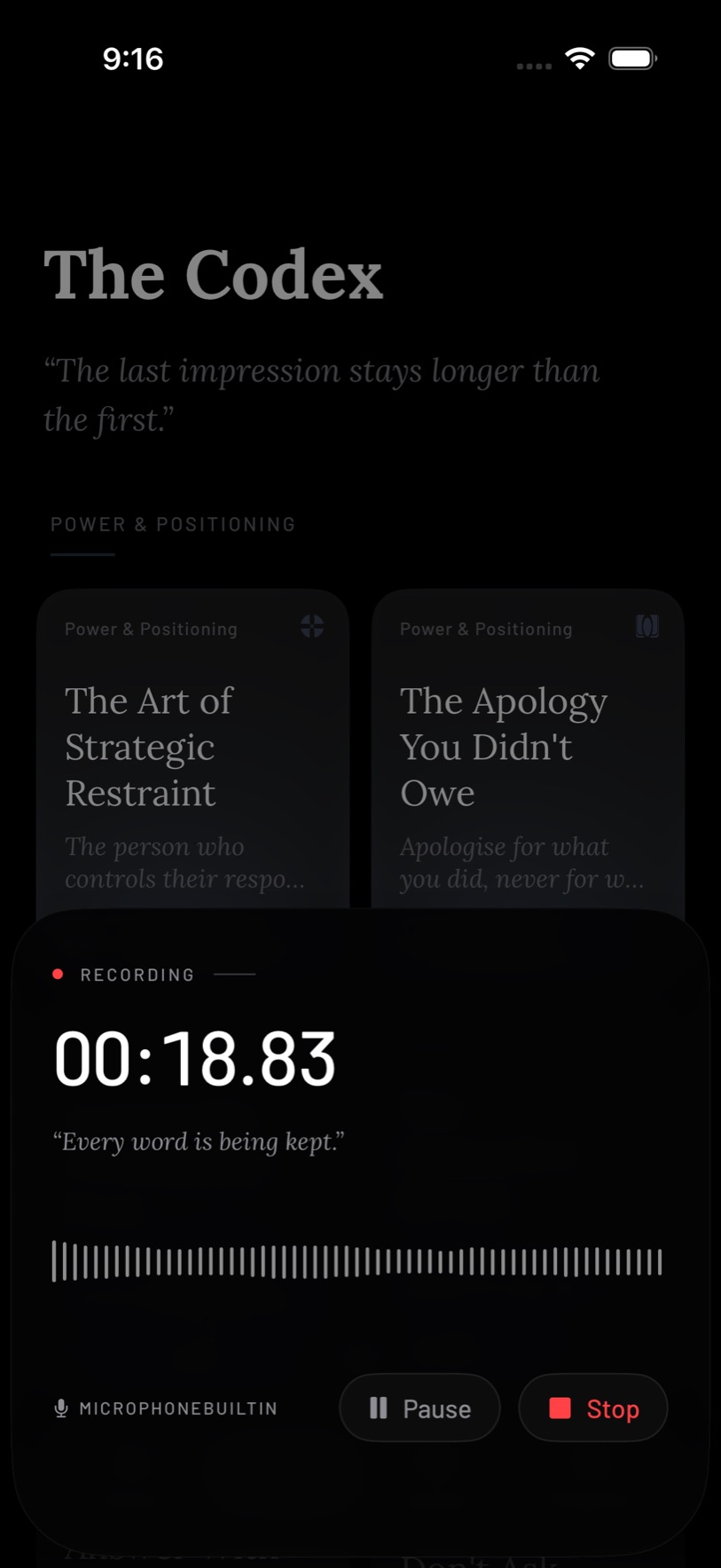
Record it
Start before a meeting or a difficult call and put the phone away. It runs up to an hour, with a Live Activity on the Lock Screen.
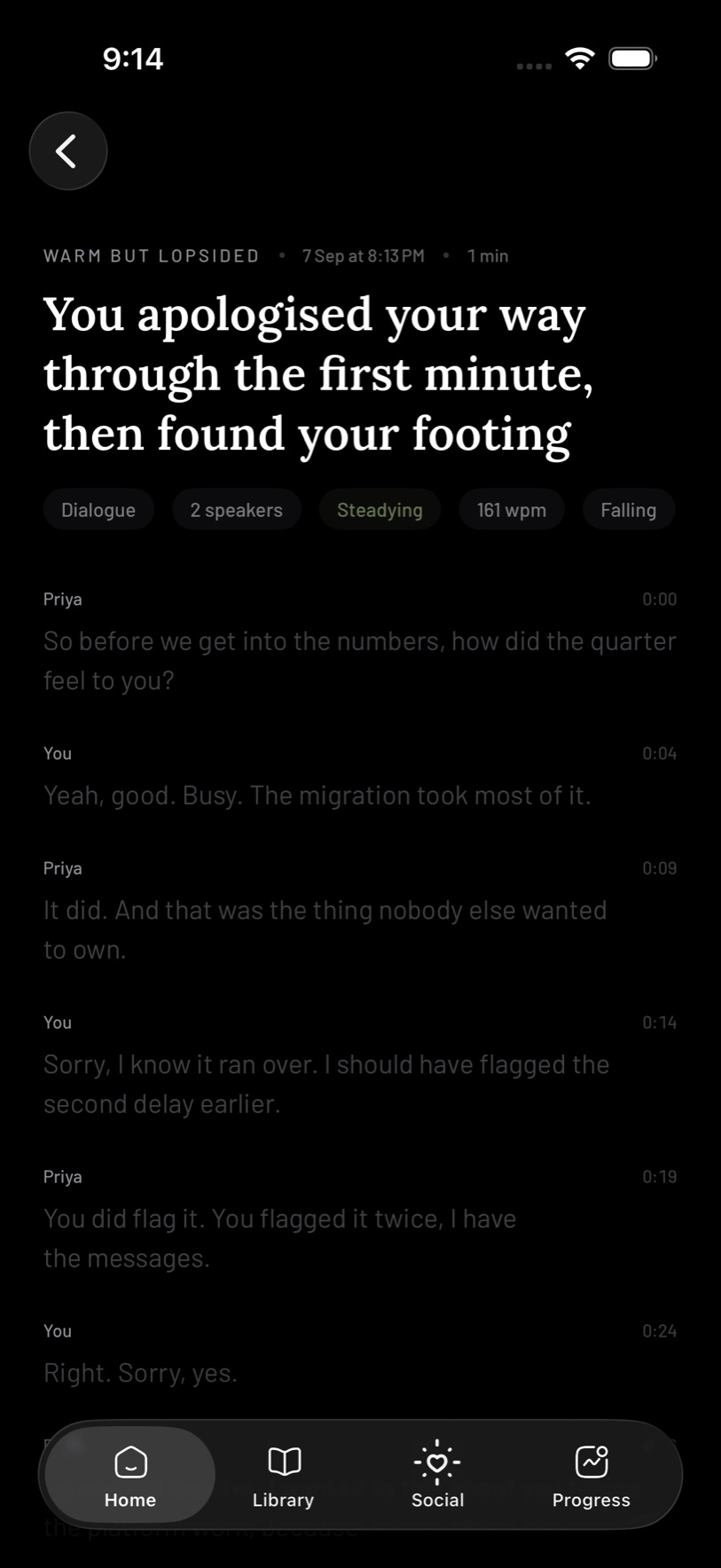
Read it back
It transcribes the conversation and works out who spoke when, so you get the whole thing as text with names and timestamps.
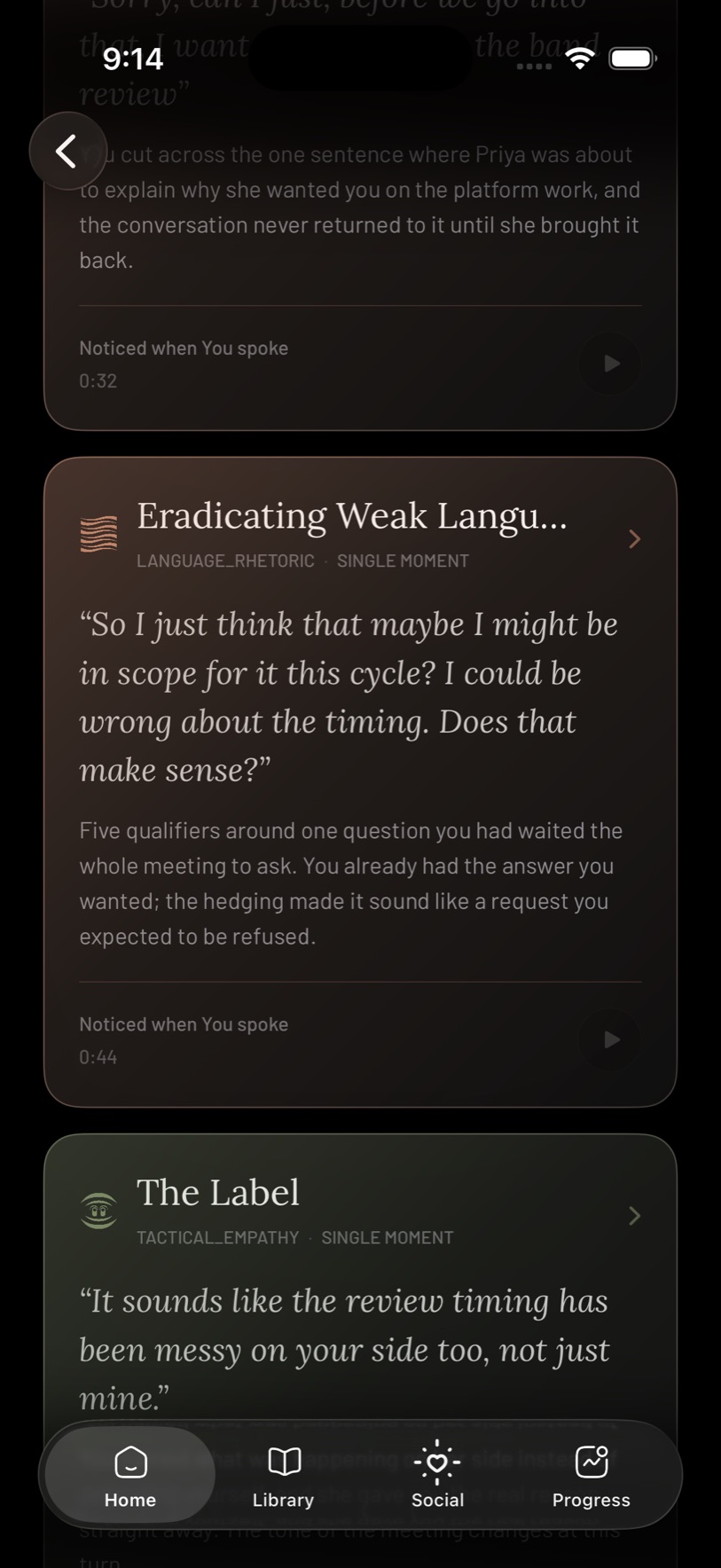
See the habit
Every moment that mattered is marked, quoted and named. Not a score out of ten: the sentence, and what it did.
Record it once. Read it back like a script.
Start a recording before a meeting, a difficult call, a dinner. The app transcribes it, works out who spoke when, and hands you the whole thing as text you can actually study.
It knows who said what
Speakers are separated automatically, and the people you talk to most get recognised by voice across conversations, so patterns follow a relationship rather than a single recording.
Measured, not guessed
Speaking pace, how much of the airtime you took, how long your pauses ran, and how clearly you were heard. Numbers you can watch move.
The habits you cannot hear yourself doing.
After a conversation the app marks the moments that mattered and names the pattern behind each one. Not a score out of ten: the specific sentence, quoted, and what it did to the room.
The interruption pattern
Who cuts across whom, in which direction, and whether it changed the subject. A conversation can be perfectly polite and still be one person steering the whole time.
The hedge before the ask
Sorry, just, I might be wrong but. Each one is small. Stacked in front of a request they quietly tell the other person the request is negotiable.
The pressure you did not name
Manufactured urgency, an obligation you never agreed to, a false choice between two options someone else picked. Easier to see in a transcript than in the room.
The question you never returned
They asked about you. You answered and stopped. The second question is most of what people mean when they say someone is good to talk to.
Sure. Go ahead.
So I just think that maybe I might be in scope for it this cycle? I could be wrong about the timing. Does that make sense?
You are in scope. I put you forward three weeks ago.
Rehearse the conversation you are dreading.
Reading about a technique does not install it. Talk to a counterpart out loud, one that pushes back, goes quiet, gets defensive, and find out what you actually do under pressure.
Live, out loud, in real time
A voice conversation you speak into, not a chat window. The counterpart plays a person with something at stake, and does not break character to coach you.
Scored against the thing you practised
Scenarios are graded on whether you did the specific thing the lesson teaches, with the moment quoted back so the score is checkable rather than an opinion.
Eleven chapters, and the library keeps growing.
Every lesson carries scenarios to rehearse and challenges to pass, and new ones land as the library grows. They unlock when the app sees the pattern in something you actually said, not when you tap through them, and mastery is measured from counted behaviour across real conversations.
Power & Positioning
Restraint, revealing on purpose, refusing to apologise for existing.
Tactical Empathy
Labelling, the last three words, the trap of trying to fix it.
Manipulation Detection
Gaslighting, DARVO, debts you never agreed to, the missing third option.
Social Dynamics
The cold open, the second question, the graceful exit.
Also: Persuasion & Influence, Psychology & Inner Game, Leadership & High Stakes, Voice & Articulation, Language & Rhetoric, Conflict & Pressure, Structural Patterns.
Your recordings stay yours. They are never sold, never used to train models, and you can delete any of it at any time.
From the journal
All articlesI recorded a meeting I thought had gone well and read the transcript the next morning. I had apologised four times for things that were not mistakes, asked one question in forty minutes, and talked for slightly more than two thirds of it. None of that is who I think I am.
No book was going to tell me that. Only the transcript could, and the transcript is not flattering, which is exactly why it is useful. This app is the thing I wanted that morning: a mirror for the part of yourself that everyone else can see and you cannot.
Shreyas · Brainsugar Studio
Find out what you
actually sound like.
Built for iPhone · Free to start